Uganda has made considerable progress in improving child survival and development. Between 2011 and 2016 maternal and under-five mortality declined from 438 to 368 per 100,000 and from 90 to 64 per 1,000 live births respectively. Improvements in socio-economic conditions, as well as the availability and utilization of essential health services, contributed to this progress.
Neonatal mortality ( 27 per 1000 live births) still represents 42% of all deaths under 5.
Despite these positive trends, progress has been slow with neonatal mortality stagnated (at about 27 per 1,000 live births) and is responsible for 42 per cent of all under-five deaths. One-third of child deaths is due to malaria, pneumonia and diarrhoea.
"Even amongst higher level health facilities in Urganda, availability and quality of maternal and newborn care was low or non-existent." - Studies on newborn care in Uganda (3-6)
Uganda has made considerable progress in improving child survival and development. Between 2011 and 2016 maternal and under-five mortality declined from 438 to 368 per 100,000 and from 90 to 64 per 1,000 live births respectively. Improvements in socio-economic conditions, as well as the availability and utilization of essential health services, contributed to this progress.
1.68 doctors per 10,000 people
12.38 nurse and midwives per 10,000 people
Before NNETS, there were 0 neonatal nursing programs in Uganda
Neonatal Nurses' Essential Training and Skills
Program:
NNETS Program: (Neonatal Nurses’ Essential Training and Skills)
Mission:
Provide state of the art training for neonatal nurses and develop strategies for sustained capacity building of medical manpower that provides care for newborn infants in Uganda
Method:
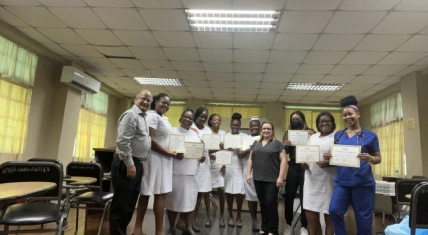
A hybrid program of neonatal nurse training that includes 40 online sessions over 6 months (March to September 2022) and 5 weeks of on-site mentorship and skills training (September 24 to November 28, 2022) using an experienced faculty of neonatologists and neonatal nurse educators.
Completion:
Provide state of the art training for neonatal nurses and develop strategies for sustained capacity building of medical manpower that provides care for newborn infants in Uganda
Oversight – COINN, Inc and Connecticut Children’s Center for Global Health
Budget:
Year 1 – $ 12,000
Funding:
Faculty Time & Effort:
Support expenses:
Travel expenses:
Boarding/ Lodging:
Volunteer – without any remuneration
Donations from viewers like you, MERUnlimited, Connecticut Children’s
Donations from viewers like you
Nakasero Hospital
Here’s how you can help
Cash Donation
US $100 can fund a week of intensive neonatal care training. US $500 can sponsor training one nurse in basic neonatal care skills — our goal is to train 20–25 nurses.
Donation of Time and Knowledge/ Skills:
If you are a trained neonatal provider, you can volunteer your time to teach by joining our teaching faculty. (Contact Dr. Naveed Hussain – hussain@uchc.edu)
Sharing information:
Please share this information with your family, friends, and co-workers and invite them to participate in improving neonatal care by training neonatal nurses.
Scan to donate via MERU
Will you join us in creating a lasting legacy of care and compassion?
Please visit the NNETS webpage, which shows how a similar program was completed in Kampala, Uganda: https://www.nccirls.com/nnets. If you are interested in making a tax-exempt donation, please scroll down to the bottom of the NNETS webpage for the link or use the information above:
The QR code will lead you to the MERU PayPal donation page, where you can select or write in the NNETS program and donate. If the QR code does not work, please use this link:
If you have Zelle® App – use merunlimited@gmail.com to make payment We also accept your tax-exempt donations by cash or check* at the following address:
Medical Education Resources Unlimited P.O. Box 370143, West Hartford, CT 06137
*Please make checks payable to Medical Education Resources Unlimited. Memo – NNETS